
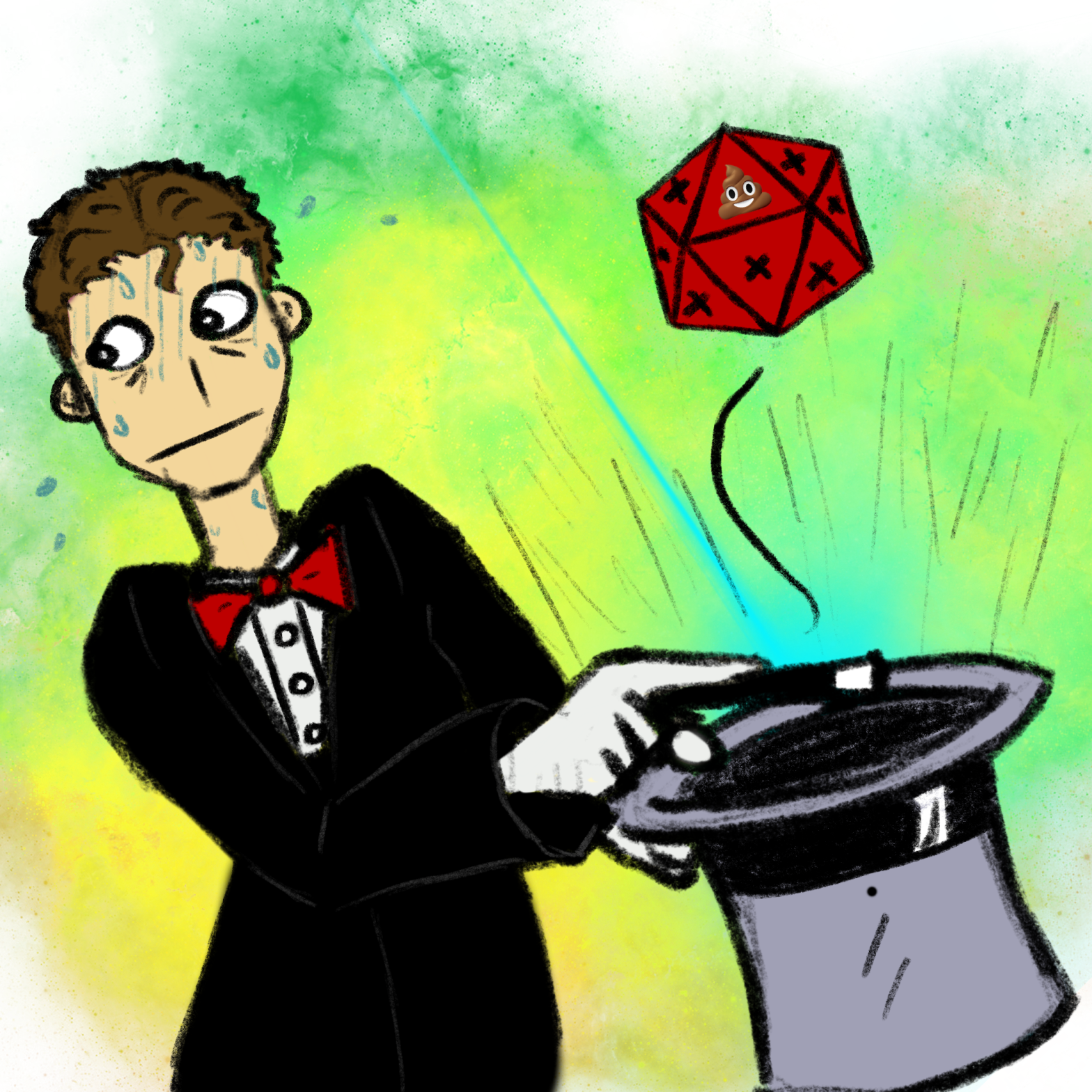
Being the DM is hard.
That’s probably the most lukewarm take imaginable, but it’s true. You have to act as narrator, supporting cast, rulebook, judge, game engine, researcher, tactician, and even psychiatrist, if your players have woven their personal trauma into their characters (which they absolutely will have).
Plus you have to be ready for questions like ‘What happens if I drink the slime?’ or ‘Can I try to join the Rat King’s hivemind if I tie my hair to it?’ and you can’t even hit your players because there’s a pandemic on because that would be unethical.
But then… is it really that hard? Sure, you’re responsible for everything in the world of the game, and you have to plan what’s going to happen (or at least get good at improv), and you’re the one that’s desperately searching through your books for a table of slime flavours… but it isn’t as hard as everyone seems to think it is.
It’s simple if you know the tricks.
I mean, all you did was roll on a chart in the book. All you did was ask what the players wanted to do, and then let them do it. In that fight where the Druid did 100+ damage in a single round? Yeah, it was cool, and everyone remembers it even months later, but you forgot the lightning resistance and now you feel like you cheated them!
When your players are saying thanks for a fun session, all you can think is: They wouldn’t be thanking me if they knew what a shambles it was. But you can’t say that out loud! Just thank them for being good players! After all, if they knew the mess that had been going on behind the scenes, that’d ruin the illusion of competence you’ve set up, maybe forever.
This is the Magician’s Guilt.
Magician’s Guilt is a term I first heard in a conversation with the owner of my Friendly Local Game Store. He’d usually set up at a little table near the back and try to cure my psychological issues whenever I went in (In the years since the store closed, I believe he’s actually gone on to become a therapist. Good to know I was an appetizer).
Anyway, we were talking about being the Dungeon Master vs being a player. I’d lobbed out the same analogies I always do:
‘Running a game is all about spinning plates, but the plates are behind the DM screen. Your players don’t realise how hard you’re working to keep everything spinning unless they hear one break.’
Or my favourite: ‘The DM is like a swan in a pond, looking all serene and graceful above the water, but underneath their legs are kicking furiously to stay afloat, and also they just want to eat some bread.’
When he didn’t look sufficiently mind-blown by my tepid insights, I ended up asking, ‘Do you know what I mean?’
‘Oh yeah,’ he said. ‘That’s Magician’s Guilt.’
He explained it thus: there’s no such thing as magic. The magician knows this. The audience knows this. Therefore, the magician must trick their audience.
But because the magician knows how the trick works, and the audience does not, the magician begins to see themselves as some unscrupulous deceiver.
Sure, close up magic seems hard, but really all you’re doing is distracting them with patter while you palm a card. And they thought they’d drawn one at random, but you’d made sure it was the twelve of clubs or whatever with a false shuffle.
It’s simple if you know the tricks.
He told me he feels this guilt so strongly that it sometimes impacts his ability to run a game. And I knew exactly what he meant; there are times I’ve had to call off a session because all I had prepared was a table of random encounters and my players would see right through it and feel cheated.
‘So how do you get past that feeling?’ I asked.
‘I wish I had a solution,’ he said. And the conversation moved on. But, like most of my conversations with the guy, it stuck with me (I’m writing a post about it months later).
If you look into Magician’s Guilt as discussed by actual magicians, their principle concern is not with the guilt itself, but with its impact on their performance; on their ability to lie and say ‘this is an ordinary £5 note’.
Their solution is simply to practice. According to close-up magician and Magic Circle Member Ben Williams, ‘People don’t really know what a magician has in their pockets… You can always justify it by telling yourself that you cannot give someone the wonderful experience of magic without a little white lie here and there!’
Like I said before, the audience knows magic isn’t real. But they still show up. It’s irrelevant what is or isn’t going on up the magician’s sleeve, what matters is that moment when the magician asks ‘is this your card?’
Chances are, the players can see the swan’s legs kicking away, at least some of the time. But that doesn’t matter. It’s not about the tricks. It’s about the fact that you learned them well enough to focus on the show itself.
When I’m a player and I think the DM is pulling names from a table, I don’t think ‘Bah, look at them needing to roll, I know how it’s done’. I marvel at how they implement the results of the roll into the story.
Look. I get wanting to make your games look effortless. Back when I started DMing, more than a decade ago now, I actually used to pretend I hadn’t prepared anything at all, to try and fool my players into thinking I was better than I really was, and maybe have them look past my mistakes.
Nowadays, I’ve grown past that way of thinking, at least most of the time. Being the DM is hard, even when you feel like it isn’t. If you’re feeling the Magician’s Guilt, maybe that’s because the difficult behind-the-scenes stuff comes to you easily now, and you’re devaluing the effort you put in to learn it?
Maybe you’re forgetting why your players want to be a part of your games. The tricks are easy if you know how they’re done. But it’s not the trick itself where the magic happens. It’s with the person performing it. You.
 Roll History
2 thoughts on “The Dungeon Master & Magician’s Guilt”