
Dungeons & Dragons is a game based around combat. It’s one of the game’s three pillars, and it’s a core aspect of the system. If you don’t want combat, you’re probably better off with a different system, right? This is D&D; we have Dungeons, we have Dragons, and we have the ability to be killed by a dragon at the end of a dungeon.
That’s it. That’s the game.
Trouble is, D&D – and 5e especially – suffers somewhat when you try to run a boss fight. Specifically, it suffers when when you try to run a solo boss fight. You know, a climactic showdown between the party and some obscenely powerful monster? Or even the main Villain themselves? The kind of battle that should be the most thrilling, the most exciting?
And then in practice, your players stand in a circle around the boss and kick it until its arms and legs fall off.
This is because of the action economy. The action economy, in 5e, refers to how much stuff you can do in one turn. For a player, that usually means one action, 30 feet of movement, and one bonus action and reaction if they’ve got the tools to use them. For a boss monster? Well, actually, it’s kind of the same.
Multiattacks, Legendary Actions, Lair Actions, and Legendary Resistances mitigate the issue a bit, but for the most part a boss monster and a player character have an equal amount of stuff. Yes, the boss’ stuff might hit harder than any single player’s stuff, but there’s only one of the boss when there’s several players. That isn’t a boss fight, it’s bullying!
Seriously though, I can’t tell you how many times I’d set up a climactic showdown with Phobos Darkevil the Necromancer, or the Plague King, or literally Shadow the Hedgehog but I didn’t tell my players that, only to have the actual fight play out as tedious and one sided because for every one spin attack the boss did, it’d get pelted with five turns worth of punishment.
(As an aside, I think a separate but equally catastrophic 5e problem is treating a fight as the source of conflict, as opposed to a method of solving conflict that’s been introduced by other factors. It’s the difference between ‘they enter the room and have to fight, oh, let’s say, an owlbear’ and ‘the cultists’ ritual is almost complete, and they’re more than willing to use violence to keep you from disrupting it’.
Maybe I’ll write something about this another time?)
Three Dogs
So, how do we fix this? 4e had a novel approach with Minions, a type of ugly yellow toddler ‘Monster Role’ designed to help ‘fill out an encounter’. Basically, a minion is destroyed when it takes any amount of damage, but it still needs to be attacked, so you can treat them like croutons in a bowl of soup; scatter a few on top to add a bit of additional crunch to your encounter.
The trouble with that approach though is twofold: one, adding more monsters sort of defeats the point of a solo boss fight, and two, once they’re all gone? Your players stand in a circle around the bowl, and they’ve all got their own spoons, and I shouldn’t have extended that metaphor.
So what’s different with our approach? Well, I can’t tell you yet. First we have to talk a little bit about Greek mythology! No, seriously.
Chances are you know a bit about Cerberus. In fact, you’re reading an article about D&D boss encounters, of course you know about Cerberus. Big dog. Three heads. Name possibly comes from the Sanskrit word k̑érberos, meaning “spotted”, which is huge if true.
Specifically, we have to talk about Euripides’ version of Cerberus. See, Euripides said ‘Alright, yeah, Cerberus has three heads, yeah, but he’s also got three bodies too.’
And his friend Eumenides says ‘Surely that’s just three dogs, squire.’
And in response Euripides goes into exile in Macedonia.
But let’s assume for a minute that Euripides hasn’t lost his little oil flask, and that despite having three bodies, there was only one dog. What if Heracles shows up and hits one of Cerberus’ bodies with his club?
Well, Cerberus is still alive, obviously. But now instead of biting Heracles three times, it can only do it twice, since now it only has two slots in the initiative order. Wait hold on I dropped the metaphor—
The Modular Monster
Let’s keep on using Cerberus as our example. He’s got three heads and three bodies, but he’s just the one dog. We don’t need to tell our players about the multiple bodies, as far as they’re concerned, he’s one dog with the normal amount of bodies for a dog. Let’s not muddy the waters.
These three bodies mean three entries in the initiative order, so three pools of hit points, and a little more balance in the action economy. They also mean unique abilities for each one—let’s say there’s a fire head, an ice head, and uh a gravy head.
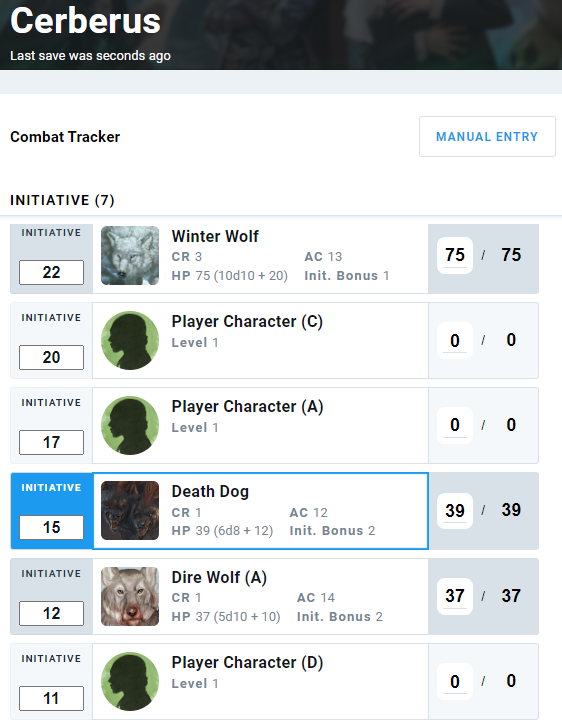
When combat begins, you proceed as normal. You pick one of the bodies – let’s call them ‘modules’ – to take damage first, and when that one dies, you remove it from initiative like any other monster. Simple! And now, phase two has begun: the boss can no longer use its gravy breath weapon, so you change up your tactics, relying now on other attacks. You tell the players that the gravy head has closed its eyes, but the other heads look even angrier.
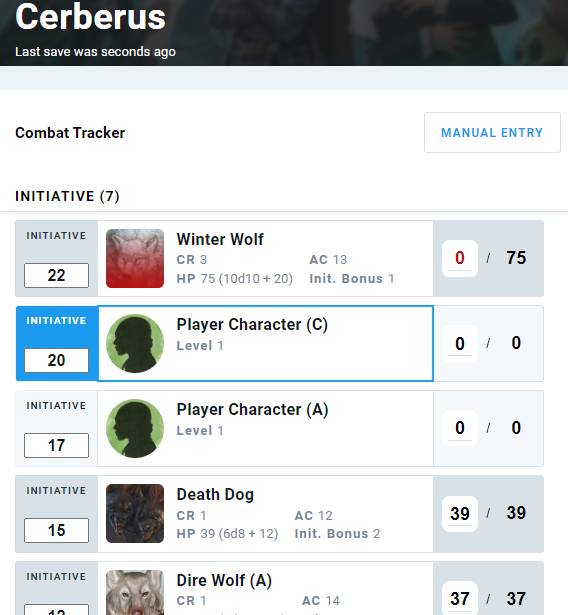
When all but one of your boss’ entries in initiative order are gone, you’re in the final phase. The boss is slower now, as far as action economy goes, and your players will have noticed this, especially if you’ve been describing the physical changes as modules have been removed! This is when you bring out the big guns, or even try to escape. The boss knows it’s on the ropes, and from both a mechanical and narrative perspective, it all comes down to this.
Maybe your players still end up standing in a circle and kicking the boss until its limbs come off. But this way, they’ll have earned it.
Benzene
At its heart, what we’re doing with this approach is disguising a group of enemies as a single entity. When you think about it that way, it seems really simple: 5e struggles to have solo monsters pose a threat, often just lumping them with more hit points so they survive longer and turn every fight into a slog. 5e combat is fun when there are a variety of targets to target. So all we do is turn the latter into the former.
But it works!
I’ll finish up with an example from the Sunday game I DM; a fight at the end of a six-session story arc involving a convention for Dragons, a heist, and a kidnapped parent. The arc’s villain – a demon named Benzene – called for a kind of hostage exchange: the aforementioned kidnapped parent for the loot from the heist.
But I built a boss fight, you know, just in case the players didn’t want to negotiate. And I decided to try this new idea.
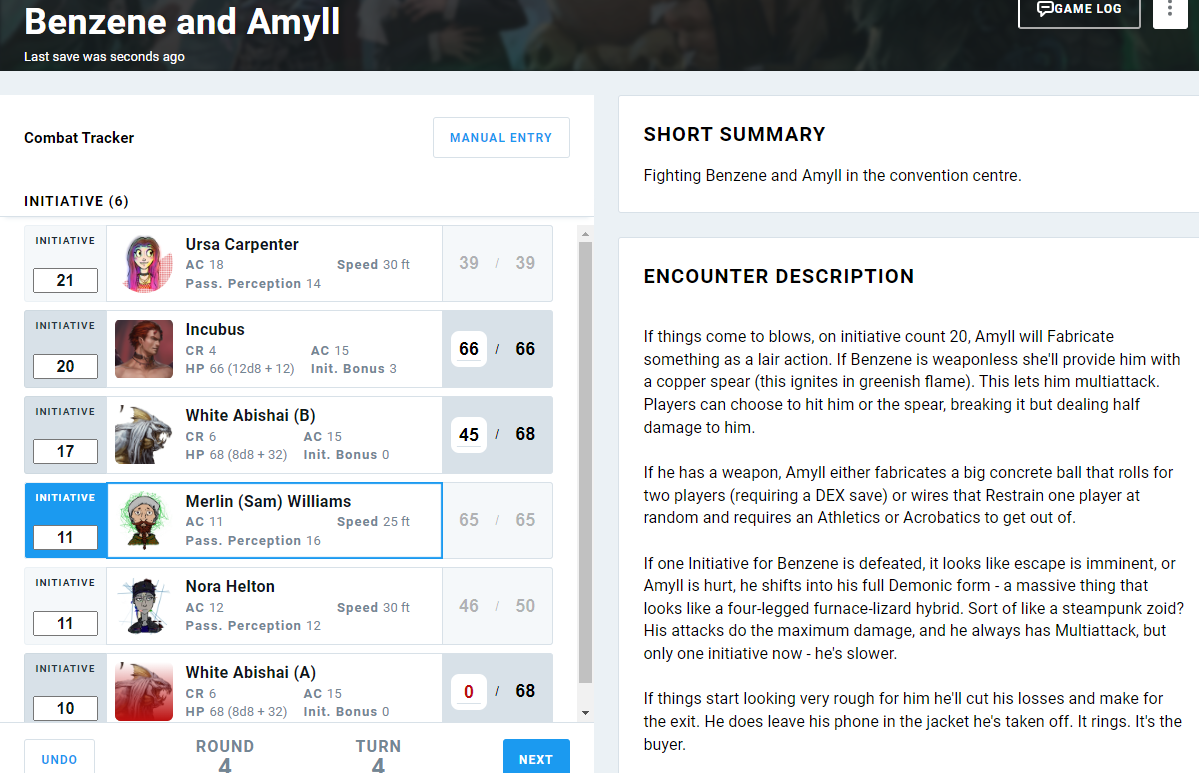
In this encounter, Amyll, his wife and partner in crime, is represented with an Incubus statblock. She’s also responsible for Lair Actions, not actually taking part in the combat and instead guarding their hostage in another room.
Benzene himself I represented with two White Abishai. I kind of picked them on a whim because they had spears! In the narrative, though, Benzene is just one man – he comes out fast, and gets a spear after the second round’s lair action (the first is used to create a big ball of concrete that rolls towards the PC searching for the hostage).
After a fairly even fight, one of the Abishai is killed, so Benzene now has just the one turn in each round. He sheds his humanoid form and pulls out all the stops. The players feels the sense of progress, and press their attack further! They’ve slowed him enough though that with their advantage in the action economy, they can afford to split their attention between the fighting and their actual goal – rescuing a hostage.
It was a lot of fun to run, and my players seemed to enjoy themselves! All in all, considering this was the test run for a new style of building encounters, I couldn’t ask for a better result.
So, next time you’re struggling to create a balanced and compelling boss fight in 5e? Just put three dogs in a trenchcoat. If anyone asks, it’s a method you learned from an ancient Greek playwright.
⁂
Plus, if you liked this article and you also like podcasts, maybe check out Roll History, where Vesper and Sami discuss stupid stuff like this regularly! Or don’t; I’m a website, not a cop
 Roll History